
How to Check Criminal History in Madera
Start with the event, not a broad name search. Madera Police can locate a city report when the requester provides the incident number or enough facts about the time and place. Its local history product is narrower: it is a check of records maintained by Madera Police for the person making the request. It is not a California DOJ rap sheet and cannot substitute for a court disposition.
Use this order to keep the record sources distinct:
- Ask Madera Police for the city incident report or your own local history.
- Check Madera County Inmate Inquiry for current or archived county custody.
- Use Madera Superior Court for filed charges, hearings, disposition, and sentence.
- Request certified court copies from the Criminal Division when proof is required.
- Use California DOJ Live Scan record review for your own statewide history.
Madera Police Local History Check
The Madera Police criminal-history page makes a key limit plain: its local check covers records maintained by that department. The applicant must appear in person with valid photo identification, complete the local form, and pay a $25 cash fee. Personal checks are not accepted. The department mails the response within two weeks, so this is not an instant name lookup.
The form asks for a legal name, birth facts, physical descriptors, other names used, current and prior addresses, identification numbers, the reason for the request, and a signature. Driver licenses, passports, military identification, and state identification are accepted; a birth certificate is not. These identity controls help prevent one Madera resident's record from being confused with another person's.
The official page view below shows where the city explains these two separate record products.
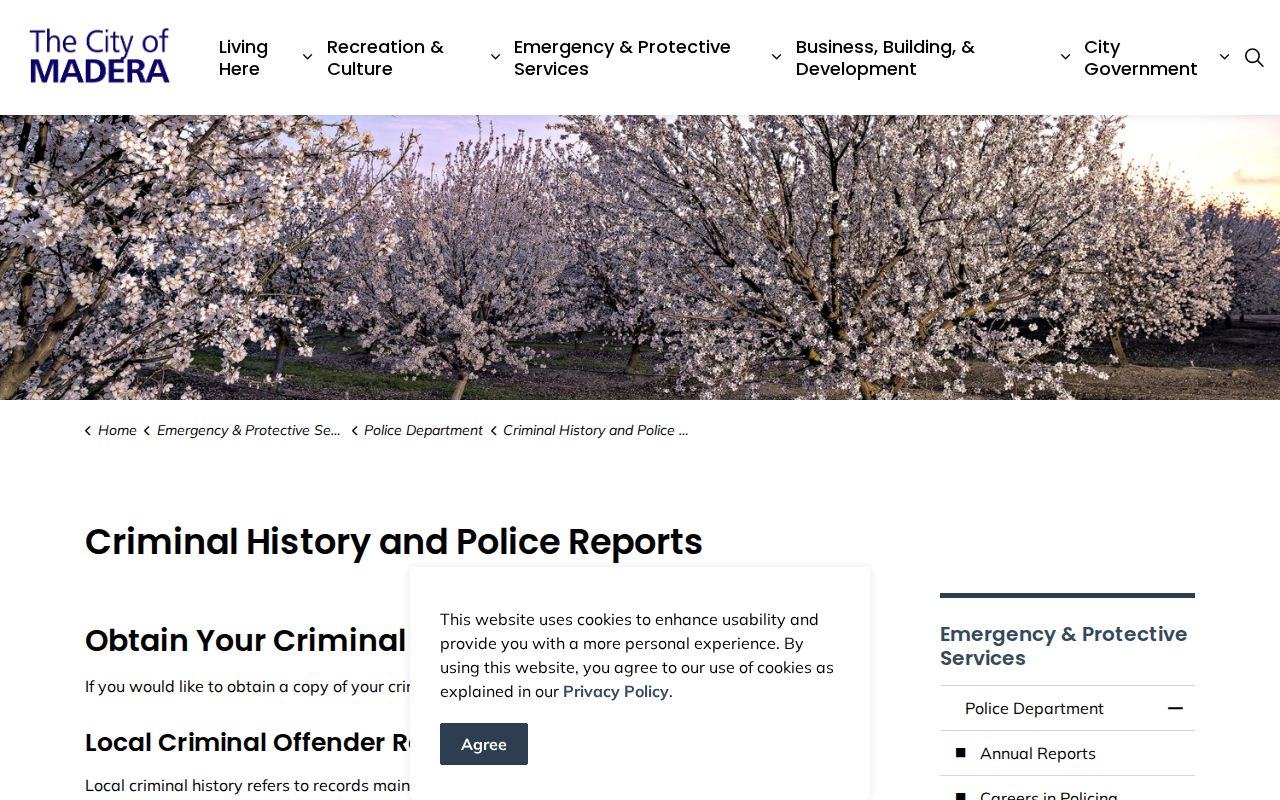
Its instructions are the right starting point for a local check, while statewide self-review belongs with California DOJ.
The Madera Police Department
Madera Police Department operates at 330 S C Street, Madera, CA 93638. Its non-emergency number is (559) 675-4220, and its crime tip hotline is (559) 675-4242. The department runs around the clock, but a records request is different from an emergency call or a tip. Ask the Crime Center about a report or local history and give enough facts to identify the event.
The official Madera Police Department page is the source for current department contact details.
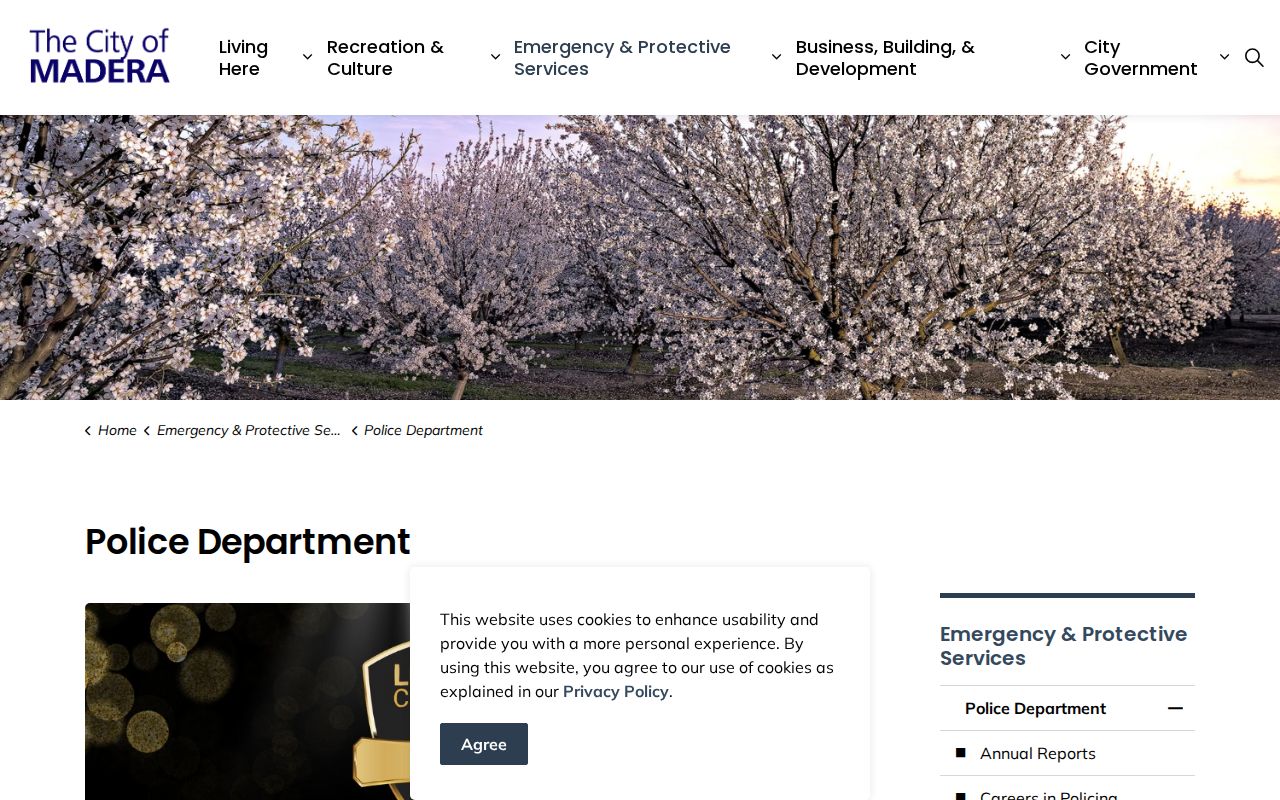
This city office holds police-created material, but it does not control county jail records or the Superior Court case file.
Madera Police Report Requests
A police report request requires an incident number or the date, time, and location of the event. Madera Police also requires notarized photo identification. The stated crime-report fee is $10, and routine processing usually takes seven to ten business days. A report may contain the officer narrative and incident details, yet release rules can remove protected facts or block disclosure.
Prepare the event details before approaching the counter. A vague name alone may not identify one incident. The local request also does not answer whether prosecutors later filed charges. For that outcome, search the Superior Court case portal or contact the Criminal Division. That division maintains the filed complaint, hearing history, disposition, and sentence. The separation matters because a police investigation can exist with no court case, and a report can remain restricted while a public court register is available.
Arrests and Bookings in Madera
Madera Police arrests move into Madera County custody systems. The Madera County Jail at 195 Tozer Street creates the booking record, and Madera County Inmate Inquiry searches that custody data by booking number or name, with an archive option for older entries. Recent custody information can also differ from the police report because booking and report files serve different purposes.
A booking may show identifying facts, charges recorded at intake, custody status, and related dates. It does not prove guilt. Prosecutors decide whether to file a case, and the court records pleas and outcomes. Readers tracing the full path should use the Madera County arrest history channels for custody detail, then move to the court record for adjudication. This keeps an allegation at booking from being mistaken for a conviction.
Madera City Hall or Police
City Hall and Madera Police accept different kinds of public-record requests. The City of Madera public-records page provides online, mail, and in-person routes under the California Public Records Act. The city normally determines whether it has responsive records within ten days, subject to a possible fourteen-day extension in qualifying circumstances. Police reports and local criminal histories still route to the Police Department Crime Center.
The source image below shows the city's general request channel.
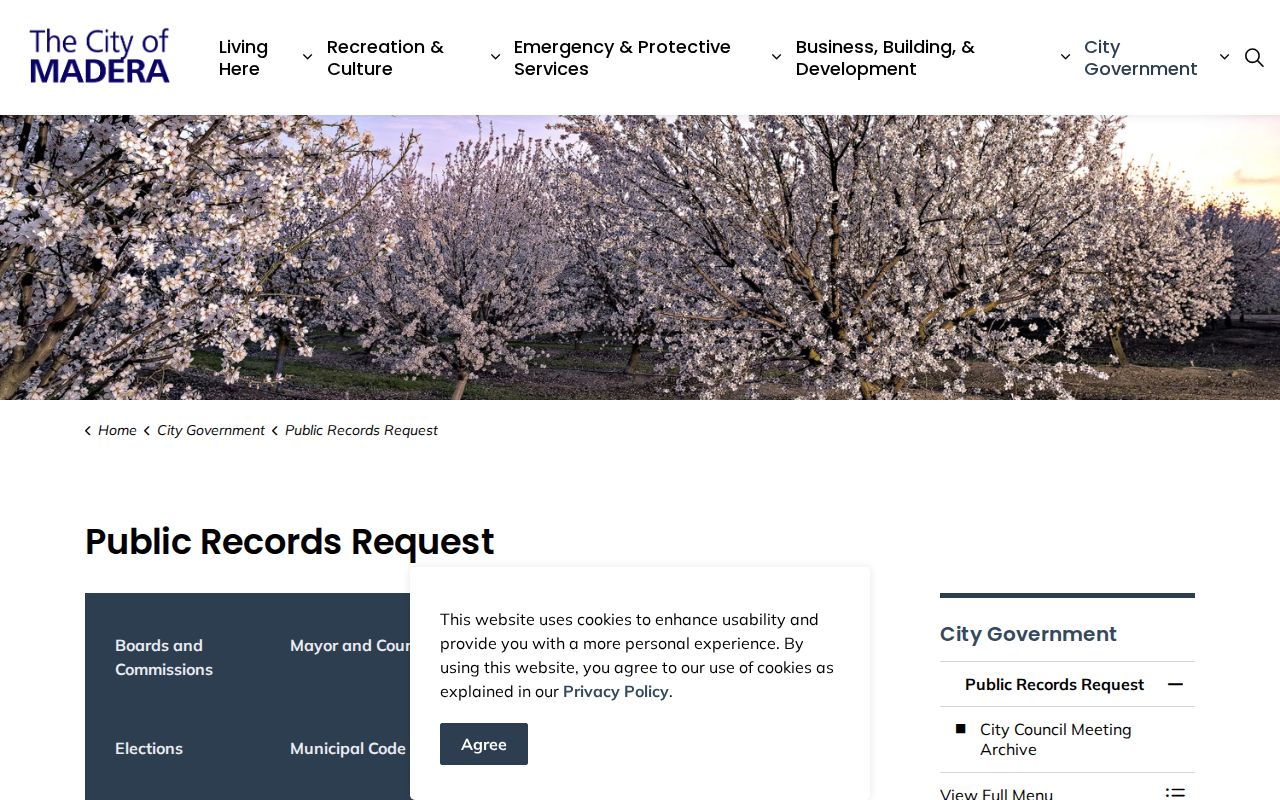
Use that citywide channel for municipal administrative records, not as a shortcut around police report release limits.
Madera Municipal Court Records
Madera has no separate municipal criminal court. City citations and criminal matters route into the Superior Court of California, County of Madera. Traffic and citation business may also appear through the court's Traffic Division and ePay-it, but ePay-it is a citation and payment tool rather than a full criminal-history search.
| Court Name | Superior Court of California, County of Madera |
|---|---|
| Case Types Heard | Felony and misdemeanor complaints; traffic and citation matters through the relevant division |
| Case Lookup Channel | Madera eCourt portal, Criminal Division counter, or mail search |
| What the Docket Shows | Filed charges, hearings, pleas, disposition, and sentencing activity |
| Copies & Fees | Record search is $15 per name; copies are 50 cents per page, with separate certification fees |
The Criminal Division is at 200 South G Street. Portal data is not the official court record unless electronically certified, so request certified material from the court when the distinction matters.
Madera Citation Search Limits
Madera ePay-it accepts a case or ticket number, a name with date of birth, or vehicle plate information. That makes it useful for a city citation or payment question. It should not be read as a complete inventory of Madera Police reports, jail bookings, or felony and misdemeanor files.
If a citation search returns nothing, confirm the spelling, birth date, and ticket number, then contact the Traffic Division. A recent matter may not yet be entered. A criminal case also may belong in the main eCourt portal rather than the payment system. This two-channel setup is a common source of confusion: one screen helps manage citations, while the court portal and clerk answer broader case-record questions.
Where Madera Records End Up
A Madera officer creates the first local incident or arrest record. If the person is booked, the county jail creates the custody entry and fingerprint cycle. The District Attorney then decides whether to file charges, and Madera Superior Court opens the criminal case. Court dispositions are reported back into the California criminal-history system, though timing and access limits can leave the sources out of sync.
Record flow: Madera Police Department › Madera County Jail and Superior Court › California Department of Justice
For a new incident, begin with police or jail records. For the legal outcome, rely on the court file. For a fingerprint-matched statewide review of your own record, use California DOJ. Local-only reports, sealed files, juvenile matters, and updates still in transit explain why one channel may show less than another.
Madera Records Versus DOJ History
California does not provide a public portal where anyone can run a name-based statewide history search on another person. The California DOJ “Criminal Records - Request Your Own” process is for personal record review under Penal Code sections 11120 through 11127. A California resident submits fingerprints through Live Scan and pays the $25 DOJ processing fee plus the site's rolling fee.
Madera Police's $25 local check and DOJ's $25 processing charge buy different products. The local response concerns Madera Police records for the applicant. DOJ compiles fingerprint-linked California summary history from reporting agencies. Neither one replaces certified court records. If a DOJ record lacks a final disposition, compare it with the Madera Superior Court file and follow DOJ's correction process rather than assuming the event ended at arrest.
Public Access Rules for Madera Records
California law separates ordinary city records, court records, and confidential state summary history. The California Public Records Act governs requests to Madera agencies, but exemptions protect investigative material, privacy, juvenile records, sealed matters, and other restricted information. Court access follows judicial rules, while DOJ rap sheets have separate dissemination limits.
Key Statutes:
California Public Records Act gives access to many agency records while allowing specific exemptions.
Penal Code section 11105 limits access to state summary criminal-history information.
California Rule of Court 2.503 governs public electronic access to trial-court records.
Correcting a Madera Record
When records conflict, identify which custodian created the disputed fact. Madera Police can address a local report or identity issue in its own file. The Superior Court clerk can supply the official register and certified disposition. California DOJ provides a formal process for challenging inaccurate or incomplete entries in a personal state record review.
Bring precise identifiers: report number, booking number, case number, full name, date of birth, aliases, and the approximate year. Do not ask one office to rewrite another office's file. A court disposition can support a DOJ correction, while the police agency may need its own documents to resolve a local incident record. Relief under Penal Code section 1203.4 or automatic relief statutes also does not erase every historical fact or make every record vanish. Confirm what each order changes with the court that entered it.
A good comparison begins with the Madera Police local-history form. Check the applicant name, date and place of birth, physical descriptors, other names, and addresses supplied for the prior five years. The form also requests a driver license number and state, plus a reason, signature, and date. Those details show what the department used to match its local files. If one item was entered incorrectly, identify that field and bring valid photo identification to the Crime Center. The city accepts a driver license, passport, military identification, or state identification for the local request, but not a birth certificate. A response is mailed within two weeks, so keep the submitted form and receipt until it arrives.
Next, compare the police response with the county sources. An incident number ties the request to the Madera officer's report. A booking number identifies the jail cycle. A Superior Court case number identifies the filed prosecution. The court portal can help locate the register, but the portal warns that its display is not the official record unless electronically certified. Ask the Criminal Division for a certified disposition when the exact plea, dismissal, or sentence is at issue. Mail searches should include the full name, date of birth, aliases, and other known facts. The court's MAD-CRM-001 search covers records from 1980 forward, or from the year the subject turned eighteen.
Finally, compare that certified outcome with a personal California DOJ record review. DOJ receives arrest and disposition reporting through the fingerprint-linked state system, so an old or missing outcome may require documents from the court that decided the Madera case. Automatic arrest or conviction relief can change access and reporting for a qualifying record, while a Penal Code section 1203.4 dismissal has its own legal effect. None of those forms of relief authorizes a requester to guess what a database should show. Read the order, confirm the case number, and send the correction to the custodian responsible for the entry.